How Long Does a Resin Driveway Last? UK Durability Guide
A flawless resin driveway doesn’t fail because of the decorative stone on top; it fails because of the unseen engineering buried underneath. If you find yourself asking how long does a resin driveway last, you’re likely planning a substantial exterior enhancement whilst quietly dreading the thought of unsightly cracks, loose aggregate, or weed growth appearing after just two or three harsh winters. Nobody wants to commit to an expensive home improvement only to watch it lift or discolour under unpredictable British weather.
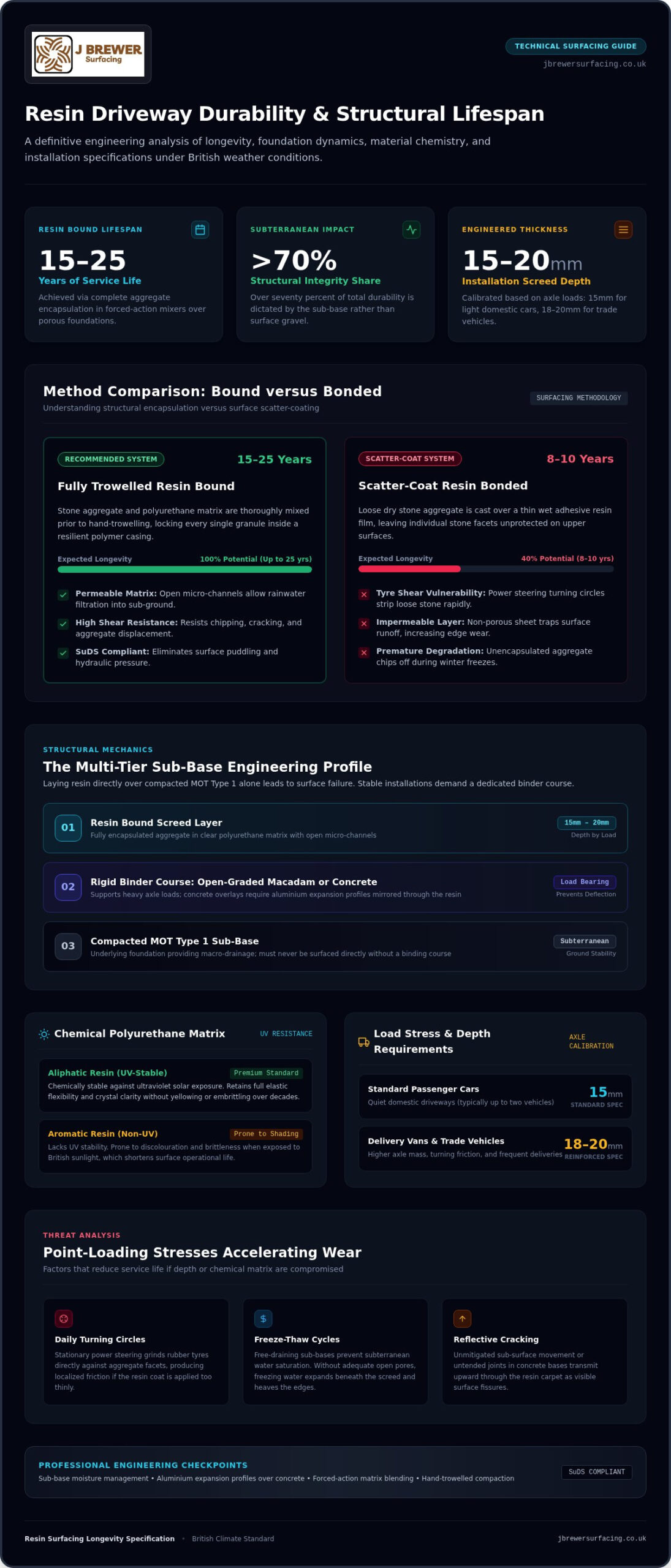
When installed with meticulous craftsmanship over a fully prepared, porous foundation, a premium resin bound system will comfortably deliver a resilient service life of 15 to 25 years. In this guide, you’ll discover the vital structural differences between bound and bonded methods, learn whether your existing tarmac or concrete base can be safely overlaid without excavation, and gain straightforward maintenance instructions to safeguard your property investment for decades to come.
Key Takeaways
- Discover realistically how long does a resin driveway last under everyday vehicle use, and why complete aggregate encapsulation protects the surface for 15 to 25 years.
- Understand why subterranean ground preparation accounts for the vast majority of surface durability, shielding your driveway against shifting and reflective cracking.
- Compare resin bound surfacing with traditional block paving and tarmacadam to see how seamless construction eliminates weed infestation and joint erosion.
- Identify straightforward care routines that maintain open-pore drainage, prevent moss accumulation, and protect your exterior investment for decades.
- Recognise the vital site considerations, from sub-base moisture to precise hand-trowelling, that professional installers manage to ensure enduring stability.
Understanding Resin Driveway Lifespan: How Many Years Do They Last?
A professionally installed resin bound driveway typically achieves an operational lifespan of between 15 and 25 years. Reaching that quarter-century mark requires far more than aesthetic care; it demands total physical encapsulation of every aggregate particle within clear, high-grade resin. When stone and polyurethane matrixes blend thoroughly in a forced-action mixer, every void bonds securely, leaving open micro-channels that allow rainwater to filter freely into the earth below. As modern permeable paving systems, these surfaces prevent surface puddling and hydraulic pressure that routinely undermine traditional, impermeable driveways during prolonged wet spells.
The 15 to 25-Year Expectancy: What Defines True Longevity?
When homeowners evaluate how long does a resin driveway last, the realistic figure depends heavily on daily usage patterns and vehicle loads. A quiet suburban driveway hosting two standard passenger cars will effortlessly reach two decades of service with minimal wear. However, point-loading stresses shift these calculations noticeably:
- Daily turning circles: Power steering on stationary vehicles grinds tyres against stone facets, accelerating localized friction if resin coats are applied too thinly.
- Vehicle axle weights: Frequent delivery vans or trade vehicles demand an engineered 18mm to 20mm layer depth, whereas light domestic usage performs reliably at 15mm.
- Sub-surface saturation: Free-draining foundations prevent freeze-thaw cycles beneath the screed, stopping subterranean ice from lifting the edges over winter.
Resin Bound versus Resin Bonded: Crucial Durability Differences
Confusion between resin bound and resin bonded systems often distorts homeowner expectations regarding surface durability. Resin bonded surfacing is merely a scatter-coat method where dry stone is thrown over an adhesive film. This leaves exposed aggregate vulnerable to tyre shear, loose stone dispersal, and moisture ingress that typically triggers degradation within eight to ten years. In contrast, fully trowelled resin bound installations mix the aggregate and resin together before hand-floating the slurry across a solid base.
Because every granule is locked within a resilient polymer casing, resin bound paving resists chipping, cracking, and stone loss. Dedicated surfacing specialists work exclusively with resin bound techniques for residential driveways, ensuring the structural stability required to withstand decades of relentless British weather without premature deterioration.
Crucial Structural Factors That Determine Resin Driveway Durability
The foundation beneath your driveway governs over seventy percent of its structural integrity. While a finished resin screed presents an immaculate, stone-carpet appearance, surface longevity depends entirely on what sits out of sight. When clients ask how long does a resin driveway last before showing defects, the answer always traces back to ground stability, chemical binder composition, and aggregate batching precision. If movement occurs below, that movement transfers straight to the surface as reflective cracking.
Sub-Base Engineering: Why Reinforced Concrete and Open-Grade Tarmac Excel
Laying resin directly over compacted MOT Type 1 alone invites premature subsidence. Without a rigid, binding binder course, aggregate shifts under vehicle torque, cracking the resin within seasons. An engineered open-graded macadam base provides an optimal structural layer because it supports heavy axle loads whilst letting surface water drain freely, matching SuDS requirements. As detailed in the authoritative Pavingexpert guide to paving standards, structural sub-bases must distribute loads without lateral deflection. If contractors overlay an existing concrete driveway, active movement joints must be honoured and mirrored straight through the resin layer with discreet aluminium expansion profiles, preventing uncontrolled fissures.
UV-Stable Aliphatic Resin versus Non-UV Aromatic Binders
Chemical binder selection directly dictates whether your surface survives decades of solar exposure. Polyurethane binders fall into two distinct chemical categories:
- Aliphatic resin: Chemically stable against ultraviolet radiation, this premium polymer retains flexibility and crystal clarity without yellowing or embrittling over time.
- Aromatic resin: A cheaper alternative that degrades rapidly under UK summer sunshine. UV rays break its internal polymer bonds, turning light stone shades patchy yellow and causing surface pitting within three to four years.
Professional tradespeople exclusively specify UV-stable aliphatic polyurethane for residential driveways to safeguard structural flexibility and aesthetic vibrancy.
Aggregate Cleanliness, Sieve Gradings, and Strict Resin Ratios
Even the finest resin fails if stone aggregate carries moisture or excess dust. Quarry stone must be thoroughly washed and kiln-dried before mixing; microscopic moisture pockets cause polyurethane to foam and whiten, destroying tensile adhesion. Installers combine specific aggregate gradings, typically blending 2mm to 5mm gravel with natural round stones and fine quartz sand. This gradation creates a tight mechanical matrix without resin-starved voids that could otherwise shed stone under turning tyres. If you want reassurance that your ground conditions and sub-base meet these rigorous standards, consulting a dedicated specialist for a professional resin driveway installation ensures every subterranean factor is methodically verified before work begins.
Resin Bound versus Traditional Paving: Lifespan and Resilience Compared
Weighing different driveway surfaces requires looking beyond day-one appearance to assess how each material handles years of tyre abrasion, winter freezing, and routine drainage. While traditional paving options have served British properties for generations, their inherent physical joins and non-permeable structures lead to distinct wear patterns over time. When asking how long does a resin driveway last in direct comparison to block paving or standard tarmacadam, the distinction lies in the seamless, flexible nature of cured polyurethane aggregate.
Resin Bound versus Block Paving: Sub-Base Settling and Weed Infestation
Block paving provides exceptional load distribution, yet its long-term integrity relies on the sand packed tightly between individual paviors. Over several wet seasons, regular surface runoff and pressure washing wash this kiln-dried sand away, opening entry points for airborne seeds. Weed root networks gradually expand within the bedding layer, forcing blocks out of alignment. Resin bound surfaces eliminate these vulnerabilities entirely; their seamless, fully locked matrix leaves no loose joints to erode, eliminating recurring re-sanding chores and preventing block displacement ruts.
Resin Bound versus Tarmacadam: Softening, Cracking, and Fuel Spills
Standard tarmacadam remains a practical surfacing choice, but it exhibits specific physical vulnerabilities when exposed to intense summer heat and vehicle fluids:
- Heat deformation: Prolonged high temperatures soften bitumen binders, leaving them prone to unsightly scuff marks from stationary power steering turns.
- Chemical degradation: Accidental petrol or diesel drips dissolve petroleum-based asphalt binders, creating localized softening and gravel unraveling.
- Structural flexibility: Quality resin bound matrices withstand minor fluid drips without dissolving, retaining tensile rigidity whilst offering a bespoke palette of natural aggregates far removed from functional black asphalt.
Hampshire Weather Endurance: Marine Moisture, Sea Salt, and Freeze-Thaw Cycles
For coastal Hampshire properties stretching across Southampton, Portsmouth, and Fareham, salt-laden marine air and elevated humidity place relentless stress on exterior building materials. Traditional impermeable driveways allow surface water to pool in shallow depressions, which then freezes during sudden winter cold snaps. As trapped water expands by roughly nine percent upon freezing, it exerts tremendous lateral pressure that fractures rigid concrete and fissures brittle tarmac.
Permeable resin bound paving actively avoids this destructive mechanism. Rainwater filters instantly through open pores into the free-draining sub-base below, preventing standing surface water from turning into hazardous ice sheets. Coupled with the natural thermal elasticity of polyurethane binders, the cured surface expands and contracts harmoniously across seasonal temperature swings, preserving its pristine finish through the harshest coastal winters.
Essential Care and Maintenance to Maximise Your Resin Driveway Lifespan
A well-constructed surface demands very little physical upkeep, yet modest preventative care can easily push its lifespan well past two decades. When evaluating how long does a resin driveway last in daily practice, routine maintenance accounts for the difference between a surface that looks tired after twelve years and one that stays pristine past twenty. By keeping the permeable matrix clear of ground-in grit and organic silt, you protect both the free-draining void network and the structural resin bond holding the aggregate matrix together.
Routine Cleaning: Sweeping, Washing, and Organic Stain Removal
Decomposing leaves, garden soil, and blown detritus will slowly settle into aggregate pores if left neglected. Sweeping your driveway every few weeks with a stiff-bristle broom clears wet mulch before it breaks down into a bed for algae or moss. If green growth develops in damp, sheltered corners, apply a specialist biodegradable wash rather than harsh acidic solutions. For occasional oil or fluid drips, treat the spot quickly using warm water and a mild household degreaser, scrubbing lightly with a handheld nylon brush before rinsing clean.
Pressure Washing Protocols: Avoiding Aggregate Displacement
Power washing effectively flushes out compacted silt from internal drainage channels, but uncontrolled water pressure can damage aggregate bonds. Keep your jet washer adjusted below 150 bar (roughly 2,000 PSI), maintain a working distance of at least 250mm from the surface, and always attach a wide 40-degree fan nozzle rather than a rotary pinpoint lance. Completing this gentle pressure wash once a year in spring refreshes the stone’s original colour without weakening the polyurethane matrix.
Winter Care Practices: Ice Management and Protecting Void Networks
Sub-zero conditions require thoughtful handling to protect the aggregate profile from mechanical damage:
- Clear de-icing: Spread pure white marine salt rather than coarse brown rock grit to clear frost, as quarry grit leaves behind fine clay residue that clogs drainage voids.
- Snow removal tools: Use a plastic-bladed snow shovel; steel edges can gouge, scratch, or chip cured stone edges under force.
- Rapid thaw drainage: Because water drains continuously into the sub-base, daytime meltwater will not stand on the surface or refreeze into treacherous night-time black ice.
To inspect your current surface or arrange expert exterior upkeep across Hampshire, contact J Brewer Surfacing & Landscaping for dependable local advice on prolonging your driveway’s finish.
Ensuring Long-Term Performance: Why Professional Installation Matters
Applying resin bound surfacing represents a precise chemical reaction paired with intense physical craftsmanship. The ambient temperature dictates exact catalyst ratios, ambient humidity must remain low, and the wet matrix requires smooth consolidation with heated hand trowels before curing begins. When assessing how long does a resin driveway last on a real domestic property, contractor competence and groundwork integrity represent the decisive variables that separate decades of reliable service from premature failure.
Early Warning Signs of Poor Workmanship and Cheap Materials
Inexperienced teams often cut corners that compromise the structural lifespan of the driveway within months. Homeowners should stay alert to clear indicators of improper installation:
- Cloudy or milky patches: Moisture trapped in the aggregate or sudden rainfall during the pour creates irregular white blooms across the resin matrix.
- Stone shedding: Scrimping on resin ratios leaves stones starved of adhesive, causing surface gravel to unravel during the first winter freeze.
- Premature perimeter cracking: Failing to install rigid boundary profiles allows outer edges to crumble under lateral tyre compression.
Ground Assessment Across Southampton, Winchester, and Fareham Properties
Subterranean conditions across Hampshire vary dramatically, from dense coastal silts around Portsmouth to shrink-swell clay strata inland near Winchester. Clay soils expand and contract across seasonal moisture shifts, demanding deeper foundation excavation and geotextile membranes to isolate the sub-base from shifting ground. Local site diagnostics also ensure precise surface falls, steering heavy rainfall safely away from property brickwork whilst preserving the mandatory 150mm clearance below household damp-proof courses.
Partnering with J Brewer Surfacing & Landscaping for Enduring Driveway Craftsmanship
Achieving a genuine 25-year lifespan requires open communication and transparent groundwork appraisal before a single trowel touches the stone. Operating with direct on-site accountability, experienced tradespeople inspect your ground conditions thoroughly, giving straightforward advice on whether existing tarmac or concrete can serve as a dependable base or if a fresh permeable foundation is required.
Because their core expertise encompasses groundwork excavation, block paving, tarmac, and resin bound paving, every stage of construction is handled under one standard of craftsmanship. To arrange a dependable site evaluation for your property, connect with the specialist team at J Brewer Surfacing & Landscaping to guarantee your exterior investment delivers lasting resilience and kerb appeal.
Securing Two Decades of Enduring Driveway Performance
Ultimately, discovering how long does a resin driveway last comes down to the invisible engineering beneath the stone and the chemical quality of the binder. When laid over an engineered, free-draining sub-base with UV-stable aliphatic polyurethane, a resin bound surface comfortably provides 15 to 25 years of pristine, puddle-free performance. Paired with straightforward seasonal sweeping and sensible vehicle use, your investment will easily withstand the rigours of changing British seasons without cracking or lifting.
As an independent Hampshire surfacing specialist managed with direct on-site craftsmanship accountability, we take genuine pride in getting the vital groundwork right from day one. Our proven regional experience across Southampton, Winchester, and Fareham guarantees your property receives ground preparation tailored to local soil conditions alongside a beautifully hand-finished aggregate matrix. Request an on-site survey and tailored advice from J Brewer Surfacing today, and take the first step towards a driveway built to endure.
Frequently Asked Questions
How long does a resin driveway last compared to tarmac and block paving?
A professionally installed resin bound driveway typically lasts 15 to 25 years, outlasting standard tarmac (around 12 to 15 years) and matching or exceeding well-maintained block paving. When assessing how long does a resin driveway last alongside traditional materials, resin avoids the joint sand erosion and rampant weed growth that plague block paving. It also eliminates the softening, scuffing, and bitumen oil degradation common to conventional tarmac.
Can a resin driveway crack, and what causes structural surface failure?
A resin driveway can crack, but surface fractures are almost always triggered by sub-base movement rather than failure in the resin matrix itself. If the ground shifts, subsides, or flexes under load, those stresses translate upward as reflective cracks. Inadequate sub-base depth, improper compaction of hardcore, or laying directly over fractured concrete slabs without honouring expansion joints represent the main causes of cracking.
What happens if rain falls whilst laying a resin bound driveway?
Rain falling during installation severely compromises the chemical curing process and permanently ruins the finish. Moisture reacts aggressively with unbonded polyurethane resin, forming trapped gas bubbles that cause cloudy, milky discolouration and weaken structural tensile strength. Professional surfacing teams track regional weather radar meticulously across Hampshire; if sudden showers threaten, work halts immediately, and newly laid sections are protected beneath waterproof tarpaulins.
Can you lay a new resin driveway over existing concrete or tarmac?
You can overlay an existing concrete or tarmac driveway provided the current base is structurally sound, stable, and completely clean. Sound existing surfaces eliminate the expense of total excavation. However, during site inspections across Southampton and Winchester properties, contractors frequently uncover underlying subgrade movement or extensive cracking. If older slabs flex under weight, full excavation down to an engineered open-graded sub-base becomes mandatory.
Is a resin driveway strong enough to support heavy vans and caravans?
Yes, a resin bound system comfortably supports delivery vans, trade vehicles, and parked caravans when engineered to the correct specification. While light domestic traffic performs brilliantly at a 15mm depth, heavy vehicle parking requires an 18mm to 20mm layer laid over a reinforced sub-base. When evaluating how long does a resin driveway last under heavier loads, using timber spreader plates under caravan steadies prevents point-load indentation.
How do you prevent weeds from growing through a resin bound surface?
Weeds cannot physically grow up through a fully consolidated, seamless resin bound matrix because the aggregate particles are thoroughly encapsulated and locked together. Any sprouting weeds originate from airborne seeds landing on top and germinating amongst trapped surface silt or rotting leaf debris. Sweeping the driveway regularly with a stiff-bristle broom removes this organic matter, whilst an annual application of biodegradable weed killer prevents seedlings establishing.
Can damaged sections of a resin bound driveway be seamlessly repaired?
Damaged areas can be repaired, although achieving an invisible match is challenging due to the natural weathering of surrounding aggregates. Specialists neatly cut out the compromised section using a diamond blade, prime the exposed edges, and hand-trowel a fresh stone and resin mix into the void. While the fresh stone looks slightly brighter initially, blending the original aggregate recipe ensures the patch matures harmoniously over subsequent months.