
Patio Joint Repair in Hampshire: How to Fix Loose or Missing Pointing
What if fresh pointing only hides the reason your patio joints keep failing? Weeds, debris and standing water in the gaps can make paving look neglected, but they may also point to movement beneath the slabs or water that isn’t draining away properly. Effective patio joint repair in Hampshire starts with checking the joints and paving together, rather than simply filling the visible gaps.
If your pointing is crumbling or missing, it’s natural to wonder whether the slabs need attention too. The right repair depends on the condition and stability of the paving, the likely cause of the damage and the jointing material suited to the patio. Hampshire’s wet weather and occasional freezing can put extra pressure on outdoor surfaces, so sound preparation and drainage matter.
This article explains how to assess failing joints, what a careful repair involves and when recurring gaps or loose slabs may call for broader patio maintenance. J Brewer Surfacing & Landscaping carries out patio joint repairs and pressure washing across Hampshire, helping homeowners maintain existing patios without assuming replacement is needed.
Key Takeaways
- Learn to recognise when patio pointing is deteriorating and needs attention.
- Check for movement and uneven paving before deciding how to repair the joints.
- Find out when isolated gaps need a targeted fix and when wider repointing may be appropriate.
- Follow a careful repair sequence, from removing failed material to allowing the new jointing to cure.
- See when patio joint repair Hampshire homeowners need is better handled as part of professional patio maintenance.
Patio joint repair in Hampshire: how to spot failing pointing
Patio pointing is the material that fills the spaces between paving slabs. It gives the surface a neat finish and helps stop loose dirt and debris collecting in the joints. Over time, pointing can crack, crumble or disappear, leaving gaps that become more noticeable after rain or when weeds start to grow.
For patio joint repair Hampshire homeowners should check several joints, not just the most obvious gap. One isolated patch of missing pointing may be a local issue, while similar damage in different parts of the patio can indicate wider wear. Inspecting a few areas helps establish whether a small repair may be suitable or whether the paving needs a fuller assessment.
What are the signs that patio pointing needs repair?
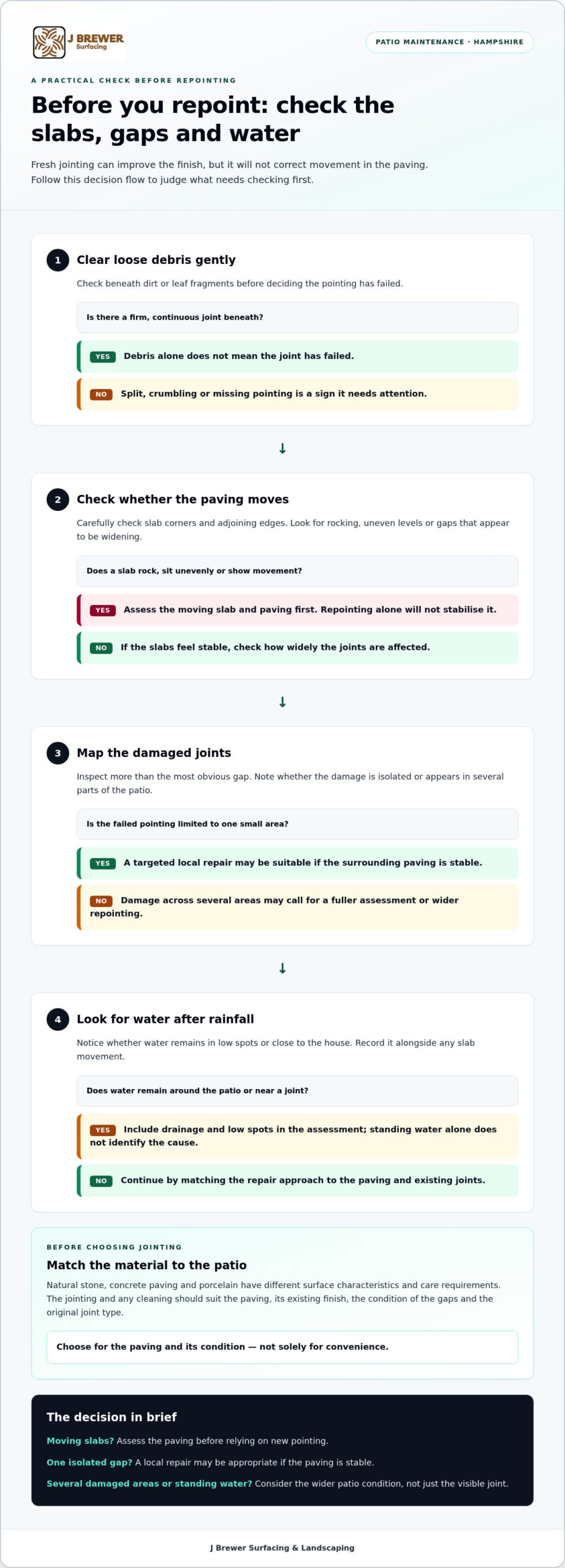
Look for pointing that has split, broken into loose pieces or come away completely. Dirt or leaf fragments in a joint don’t necessarily mean the pointing has failed. Clear away loose material gently and check whether a firm, continuous joint remains beneath it. Weeds and moss are reasons to inspect the gaps, but their presence alone doesn’t explain why the joint has deteriorated.
Check the slabs as well. If one edge sits higher than its neighbour, gaps have widened, or a slab rocks underfoot, the problem may extend beyond the pointing. New jointing material won’t correct movement in a slab. Note where the damage occurs and whether nearby paving feels stable. This gives you a clearer picture than judging the patio from one small section.
Why do patio joints deteriorate?
Joints are exposed to rain, changing temperatures, foot traffic and everyday wear. Organic growth can take hold where dirt and moisture remain, while frequent use may gradually affect the areas people walk across most. In Hampshire, as elsewhere in the UK, wet weather and colder spells are practical factors to consider when inspecting outdoor paving. They don’t prove a particular cause, but it is sensible to look for damage once the surface has had time to dry.
Standing water near a joint may indicate that water isn’t draining away readily, while movement in the paving can put strain on the material between slabs. Weeds are a prompt to inspect the joint, not proof of poor drainage or a failed base. For a general explanation of mortar joints, repointing describes renewing the external part of mortar joints in masonry construction; patio joint repairs also depend on the paving and jointing material involved.
J Brewer Surfacing & Landscaping includes joint repairs in its patio maintenance work across Hampshire. Assessing the pointing alongside the slabs helps define the repair and keeps attention on the condition of the existing patio, rather than assuming it needs replacing.
Before patio joint repair, check the paving and the cause of failure
Before replacing missing pointing, look at the patio as a whole. Fresh jointing can improve the finish, but it won’t hold a slab steady if the paving beneath it is moving or uneven. Check the surface in good light and note whether the damage is limited to one small area or appears across several sections. This helps show whether a local repair may be enough or whether the wider paving needs attention.
Walk the patio carefully and look for clues that point beyond the joints:
- Press gently on slab corners to see whether any move underfoot.
- Compare adjoining edges for changes in level or gaps that appear to be widening.
- After rainfall, note whether water remains in low spots or close to the house.
- Look at whether the joint damage follows a particular route or affects scattered areas.
These checks won’t identify the cause on their own, but they help build a clearer picture. For example, note standing water alongside any slab movement instead of treating each symptom as a separate pointing fault.
Can you repoint a patio when the slabs are loose?
Assess slab movement before refilling the joints. A single loose slab may be an isolated issue, while movement across a broader area can mean more of the paving needs attention. Repointing alone shouldn’t be relied on to stabilise loose paving. The moving slab needs to be considered when deciding the repair scope; otherwise, the new joint may be affected by the same movement.
How does paving material affect joint repair?
Natural stone, concrete paving and porcelain don’t all have the same surface characteristics or care requirements. The jointing approach and any cleaning should suit the paving, its existing finish and the condition of the gaps. There isn’t one product or method that is automatically right for every patio, so don’t choose solely on convenience.
Preparation matters, too. The National Park Service’s guidance on repointing mortar joints highlights careful material selection and application. Although it addresses masonry, its emphasis on matching materials and working carefully is relevant when considering patio repairs. The existing joint type and slab condition help determine the right preparation and repair.
For patio joint repair Hampshire projects, assess slabs and joints together rather than treating fresh pointing as a fix for movement. J Brewer Surfacing & Landscaping carries out patio maintenance, including joint repairs, across Hampshire. Explore patio maintenance in Hampshire to plan the next step for your paving.
Choosing a patio joint repair method for Hampshire paving
The repair should match the pattern and extent of the damage, the paving material and the way the joints were originally formed. A small, clearly isolated gap may need only local attention, while crumbling or missing pointing across several parts of the patio can call for wider repointing. The aim is to address the affected joints without treating every patio as if it needs the same work.
Before deciding, consider the joint width, the condition of the surrounding paving and the site’s exposure to rain and regular use. These details help inform preparation and material choice. The table outlines useful considerations rather than prescribing a universal solution.
| What to assess | How it can guide the repair |
|---|---|
| Location and spread of damage | One isolated gap may suit a targeted repair; similar deterioration across multiple areas may call for wider repointing. |
| Paving material and finish | Natural stone, concrete and porcelain have different care needs, so jointing and cleaning methods should be selected with the surface in mind. |
| Joint width and existing construction | The space between slabs and the existing joint material help determine what preparation and replacement material are appropriate. |
| Exposure and water behaviour | Areas exposed to regular use or where water remains nearby deserve careful assessment as part of planning the work. |
Mortar pointing or a jointing compound: what affects the choice?
Traditional mortar and suitable jointing compounds have different preparation and application requirements. The existing paving, joint construction and condition of the gaps should guide the choice; neither option is right for every patio. Follow the selected material’s instructions for preparing the joints, applying it and allowing it to cure. Ignoring those steps can affect the finish.
Don’t choose a material simply because it seems straightforward to apply. A jointing compound still needs the right preparation for the paving and site, while mortar work also depends on suitable joint preparation and careful finishing. Read the manufacturer’s directions, including any guidance on weather conditions and cleaning the paving. If the joint arrangement or surface is unfamiliar, assess it carefully before settling on a method.
When is a local joint repair enough?
A local repair may be appropriate when damage is confined to a small area and the surrounding joints and paving remain in good condition. If gaps keep returning or deterioration appears in several separate areas, a broader assessment can establish whether more extensive repointing is needed. Replacing slabs is a separate decision for paving that is damaged or unstable, not an automatic part of joint repair.
For patio joint repair Hampshire homeowners can use the damage pattern to help define the work, but the joints and slabs should be considered together. J Brewer Surfacing & Landscaping includes joint repairs within patio maintenance across Hampshire, with the repair scope guided by the condition of the existing paving.
How to repair patio joints: a careful step-by-step process
A sound repair depends on preparation as much as on the new jointing material. The exact method varies with the paving and product, so treat the manufacturer’s directions as essential. Before starting, check the forecast and the instructions for suitable working and curing conditions. If the weather falls outside the product guidance, wait for a more suitable time.
A careful sequence helps protect both the slabs and the finished surface:
- Inspect: Confirm which joints have failed and check that the surrounding paving is stable. Don’t refill joints around slabs that still move.
- Remove failed material: Clear loose or crumbling pointing from the affected joints, taking care not to damage slab edges or disturb sound material unnecessarily.
- Prepare the joints: Remove weeds, loose dirt and debris, then prepare the joints and paving as directed for the chosen material.
- Refill and finish: Apply the jointing material evenly, working it into the prepared gaps and finishing the surface in line with its instructions.
- Allow it to cure: Protect the repair for the period and in the manner specified by the product guidance before using the patio or carrying out further cleaning.
How should you prepare patio joints before repointing?
Clear away weeds and debris carefully, then remove failed material without widening the joint or levering against the paving. The required joint depth, surface condition and any dampening or drying instructions depend on the selected material, so follow its guidance closely. Before applying anything, check the slabs again. If one has become loose or uneven, pause and reassess the repair rather than filling around movement.
Avoid forceful cleaning. Aggressive pressure or scraping can mark paving edges, disturb sound pointing or leave the joint in a condition that doesn’t suit the repair material. Cleaning should be controlled and appropriate to the paving type. If pressure washing is part of wider maintenance, plan it with the joint condition in mind and avoid a setting that could undo careful preparation.
How should you finish and care for repaired joints?
Spread the material consistently and remove residue from the paving using the method recommended by its manufacturer. Don’t guess at curing times: follow the stated guidance for protecting the repair and using the patio again. Once it is ready for normal use, check the joints periodically for new gaps or deterioration, particularly after wet or cold spells.
For patio joint repair Hampshire homeowners can benefit from a methodical process that considers the existing slabs as well as the gaps. J Brewer Surfacing & Landscaping provides patio maintenance, including joint repairs, across Hampshire. Arrange patio joint repair and maintenance to have your paving assessed and the appropriate work carried out.
When to arrange professional patio joint repair in Hampshire
A small, isolated gap can sometimes be straightforward to address, but widespread or recurring deterioration deserves a closer look. Arrange professional patio joint repair in Hampshire if failed pointing appears across several areas, gaps return after previous repairs, or multiple slabs move underfoot. These signs can mean the work needs to go beyond filling visible spaces, with the paving condition considered when deciding the repair scope.
Which patio joint problems are harder to tackle yourself?
Widespread joint failure, repeated repair problems and movement across more than one slab can make it harder to identify the right approach without assessing the patio as a whole. Delicate or damaged paving also needs care, since unsuitable cleaning or preparation could worsen the surface. A cracked joint alone doesn’t mean the patio must be replaced; the slabs and surrounding joints help determine the right repair.
Take extra care if you’re unsure what material was previously used, or if the paving has a delicate finish that could be marked during preparation. Repeatedly filling the same gaps without considering the wider condition may lead to more maintenance. A careful assessment can distinguish local joint repairs from issues that need attention to the paving itself, helping keep the work focused on the patio’s actual condition.
How can patio maintenance help restore failing joints?
Joint repairs form part of J Brewer Surfacing & Landscaping’s patio maintenance service across Hampshire. Looking at the joints alongside the slabs helps define the work, while cleaning can be considered where it suits the patio’s condition. Pressure washing isn’t an automatic step in joint repair: the method and timing need to suit the surface and the state of the existing pointing.
If you’re in Southampton, this practical guide to patio maintenance in Southampton explains how ongoing care can help keep paving in good condition. Where cleaning is appropriate, read the advice on safe patio pressure washing in Hampshire before including it in the repair. Cleaning should complement the work, not disturb sound joints or replace repairs to failed ones.
Professional maintenance doesn’t mean every tired patio needs a new surface. The aim is to understand what has failed, decide whether joints or paving need attention, and carry out work that suits the existing materials. This can restore a neater appearance while keeping the repair focused on the patio’s condition.
If pointing is failing across your patio, or the same gaps keep returning, discuss the paving with J Brewer Surfacing & Landscaping. A tailored quotation can set out the appropriate patio maintenance and joint repair work for your Hampshire property.
Take the next step towards a cared-for patio
A patio doesn’t have to be perfect to be worth maintaining, and a few failing joints don’t automatically call for a complete overhaul. The useful next step is to consider what you want from the space and have the repair guided by the paving already in place. This gives you a clearer basis for planning, whether you’ve noticed one small area of concern or want to refresh the patio more broadly.
For patio joint repair Hampshire homeowners can discuss their paving with J Brewer Surfacing & Landscaping and request a quotation tailored to the work required. If cleaning is also being considered, discuss it alongside the joint repair rather than assuming it is needed for every job.
Discuss your patio joint repair with J Brewer Surfacing & Landscaping and take a considered step towards a neat, well-maintained outdoor space. With suitable care, your existing patio can continue to serve your home.
Frequently Asked Questions
Can you repair patio joints without lifting the slabs?
Yes, jointing can often be renewed from above without lifting the slabs. This can preserve the existing layout and avoid disturbing neighbouring paving. One practical consideration is appearance: a fresh section may look different from older, weathered joints, even when the repair is sound. If a close visual match matters, consider the colour and finish of the existing pointing when planning the work, and don’t assume a patch will weather identically.
Why does patio pointing crack or keep coming out?
Pointing may crack or loosen if the material hasn’t bonded or settled as intended, or if the joint construction and chosen material aren’t a good match. To make a recurring problem easier to assess, photograph the affected area after clearing loose debris and note when the damage returns. Comparing the same spots over time can help show whether the issue is isolated or becoming more widespread.
Can you use mortar to repoint every type of patio?
No, mortar isn’t suitable for every patio. The joint construction and paving finish both matter: mortar residue can be difficult to remove from some surfaces and may affect the finished look. Before treating a prominent area, check the paving-care guidance and consider a small, inconspicuous test area if the material instructions allow. This helps protect the surface while you assess the finish.
Will pressure washing damage patio joints?
It can, especially if the joints are already loose or the water is directed straight into them. For routine upkeep, sweep away dry leaves and grit first, then use a gentler cleaning approach suited to the paving rather than relying on pressure alone. If you’re unsure how the surface will respond, test a discreet area to reduce the risk of marking slabs or disturbing more jointing than intended.
How long should patio jointing material be left to cure?
Use the curing period stated by the manufacturer, as it varies between products. Plan around that guidance by moving garden furniture, pots and other items clear of the repair beforehand, so you won’t need to put them back too soon. Also distinguish between a surface that feels dry and one that is ready for normal use. Follow the product’s instructions for protection and when the patio can be used again.
Can weeds grow back after patio joint repair?
Yes. Weed seeds can arrive from nearby borders, pots or the wind, so renewed pointing doesn’t remove every source of future growth. Keep soil and loose mulch from spilling across the paving, particularly along the edges beside planting beds. A quick check during ordinary garden upkeep can help you spot seedlings while they’re small, before they become established or leave more debris in the joints.
Is patio joint repair suitable for wet or cold weather?
It may not be suitable if the product’s stated working conditions aren’t met, so check its label before planning the job. Read the instructions before buying materials, then choose a period when you can complete the work and protect the area as directed. For patio joint repair Hampshire homeowners should follow the manufacturer’s guidance for the specific material rather than relying on a general rule for every repair.