
Tarmac Driveway Hampshire: A Practical Homeowner’s Buying Guide
The best-looking driveway is not always the one that works best for your home. Appearance, everyday use and durability all matter when you compare tarmac with resin or block paving. This tarmac driveway Hampshire buying guide looks beyond the finished surface: your property, ground conditions and drainage all influence how to plan a successful project.
Here you’ll find practical points to consider before choosing tarmac, including how it compares with other finishes and why preparation, edging and drainage matter. Rain and cold weather can test a driveway, so it is worth considering how water moves across the site and whether the surface suits your daily needs. These details will help you plan your project and discuss a tailored quotation.
Key Takeaways
- Consider how you use your driveway each day as well as how its finish will complement your home.
- Ground preparation, levels, edging and drainage all contribute to a well-planned surface.
- Compare tarmac, resin and block paving by appearance, practical use and design flexibility.
- Plan your tarmac driveway Hampshire project around parking, access, existing surfacing and nearby landscaping.
- J Brewer Surfacing & Landscaping provides tarmac surfacing with ground preparation and professional edging for residential and commercial projects.
Would a tarmac driveway suit your Hampshire property?
A driveway should make arriving, parking and getting to your home straightforward, while also sitting comfortably alongside the house and garden. Tarmac provides a simple, continuous finish that can suit practical access and parking. If you want a more decorative surface, another option may better match your plans.
A tarmac driveway is a surfaced vehicle access area designed to provide a smooth, practical route for driving and parking. Its visible top layer sits above a prepared foundation that supports the surface. “Tarmac” is commonly used to describe modern driveway surfacing, although the historic material has a more specific meaning. Tarmacadam (or tarmac) is a road surfacing material made by combining tar and macadam (crushed stone and sand).
What can a tarmac driveway offer day to day?
A continuous surface can make it straightforward to drive in and out, manoeuvre into a parking space and move between the road and your home. Tarmac may suit households that use their driveway regularly or access areas where a practical finish matters more than a prominent pattern.
Edging defines the driveway’s boundaries and creates a tidy transition beside a path, wall, lawn or planting. This can give the frontage a more considered appearance. Tarmac’s understated look will appeal to some homeowners, while others may prefer more pattern, texture or colour from the surface itself.
Which Hampshire homes and access areas might suit tarmac?
Begin with the space and how you plan to use it. A broad, uncomplicated frontage with regular vehicle access may suit a continuous surface. A narrow entrance, turning area or space for several vehicles needs careful planning for movement and parking. Consider where visitors will park, how people will reach the front door and how the driveway will meet existing garden features.
There is no single Hampshire layout. A property in Southampton may have different access constraints from one in Winchester, and neighbouring homes can vary in frontage, levels and parking space. Existing surfacing, the ground beneath it and the route rainwater takes are also important. A surface that works well on one plot may not be right for another.
For a tarmac driveway Hampshire homeowners are considering, start by identifying how the space needs to work, not just whether you like the finish. Think through daily vehicle movements, parking needs and the relationship between the drive and garden. These practical details help shape a layout that works from the kerb to the front door.
How preparation, edging and drainage shape a tarmac driveway
A good finish depends on more than the surface visible from the road. The existing site, its levels and the way rainwater moves across it all affect how a project should be planned. Considering these details first helps create a driveway suited to the property rather than relying on a standard approach.
Suitable preparation provides a stable foundation for the finished tarmac and helps it suit its intended use. The work required depends on the condition of the existing area. One section may be even and sound, while another is cracked or settled. Assessing the surface and ground helps establish the right scope before laying a new finish.
Why the ground beneath the tarmac matters
The foundation supports the surfaced area during everyday use. Cracks, movement or uneven patches in an existing driveway may indicate that the ground beneath needs attention before new surfacing is laid. Covering a defect without addressing its cause can leave the underlying problem in place.
Preparation should also reflect how the driveway will be used. A household parking cars has different requirements from a commercial access area with regular vehicle movements. For a tarmac driveway Hampshire homeowners plan to use every day, the groundwork should be considered in relation to the site and its purpose. A site assessment helps identify the necessary work rather than assuming every driveway needs the same preparation.
How edging, levels and water management affect the plan
Professional edging defines the driveway’s shape and creates a neat transition to a path, wall, lawn or planted border. Its position should suit the layout and help the finished surface sit naturally alongside the property. A clear boundary also helps tie the surfacing in with garden features.
Levels matter too. The height and slope of the surface affect how it meets the entrance, garage, paths and surrounding ground. Conventional tarmac is not permeable, so the site plan needs to consider where rainwater will run and whether it could collect in low areas or flow towards the house. The appropriate arrangement depends on the property.
J Brewer Surfacing & Landscaping includes ground preparation and professional edging in its tarmac surfacing work, with the project planned around the site. If you’re planning a driveway, discuss preparation and edging for your tarmac project as part of developing a suitable plan.
Tarmac vs resin vs block paving: compare driveway options in Hampshire
Your driveway surface should suit both the way you use the space and the appearance you want for your home. Tarmac, resin and block paving each create a different finish. Compare them by appearance, everyday use and site conditions rather than assuming one option is right for every property. Start with three questions: how will you use the space, what look do you prefer and what are the conditions at your property?
| Surface | Appearance and design | Everyday considerations |
|---|---|---|
| Tarmac | A continuous, understated finish that gives the driveway a simple, defined look. | Its smooth surface can suit regular vehicle access and straightforward parking. Edging and nearby planting can add definition and soften the overall appearance. |
| Resin | A distinctive aggregate finish, offering a different texture and visual character from tarmac. | It can appeal if you want the driveway’s surface itself to contribute more visual detail. The base and site conditions form part of the installation decision. |
| Block paving | Individual blocks create visible joints and allow the layout to shape the finished look. | The pattern and boundaries can be prominent design features, making the choice of layout an important part of the overall appearance. |
This comparison is a starting point, not a final specification. Existing surfacing, access, levels and intended use can all affect the preparation and design. A compact parking area may call for different decisions from a wider frontage or shared access.
When might tarmac match your driveway priorities?
Tarmac may suit you if you want a smooth, continuous surface for regular access and practical parking, without making a strong pattern the main feature. Its restrained appearance can sit comfortably beside many types of home, while considered edging gives it a crisp outline. Garden borders, walls or planting can bring colour and character to the frontage without changing the driveway surface.
How resin and block paving offer different choices
Resin has a more visibly textured aggregate character, which may appeal if you want the finish to add detail and visual interest. With block paving, the individual units and their arrangement make the pattern part of the design. Neither option is automatically preferable. Decide whether you favour a quiet, continuous look, an aggregate finish or a defined paved pattern.
For a tarmac driveway Hampshire project, compare the proposed finish with your property’s brickwork, boundaries and garden. Then consider how vehicles will enter, turn and park, and how the driveway will meet paths and outdoor spaces. Knowing your priorities makes it easier to discuss a suitable surface and specification for the site.
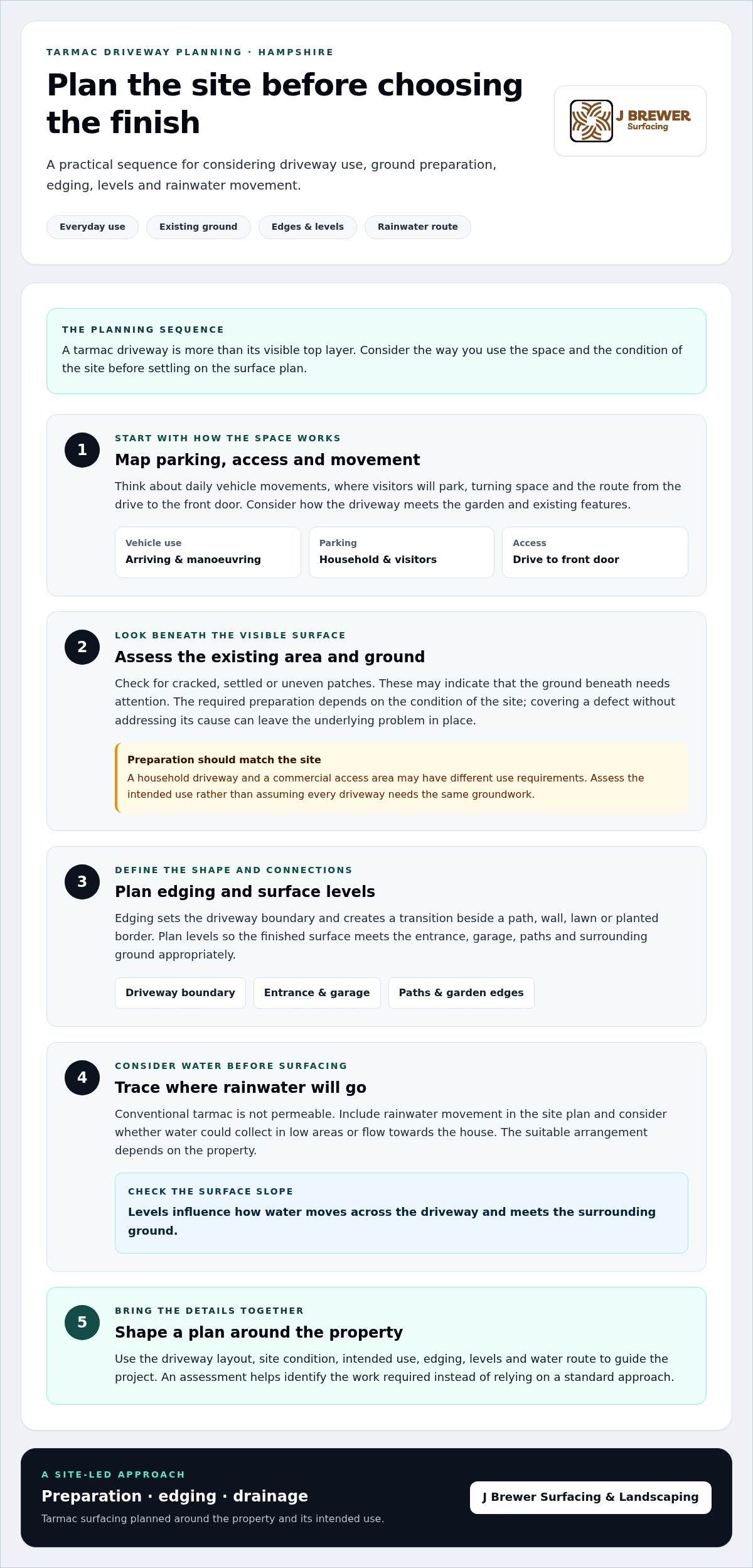
Plan a tarmac driveway project in Hampshire: a practical sequence
A clear plan helps turn an idea into a driveway suited to your home and daily routine. Start by deciding what the space needs to do, then look at the existing site before agreeing the work involved. This keeps practical needs, such as parking and garden access, in view alongside the finished appearance.
What to consider before the site discussion
Before discussing your project, make a note of how you use the driveway and what you want to change. These details help make the conversation more focused:
- Layout and parking: Sketch the area and mark where vehicles enter, turn and park, including how many vehicles you need to accommodate.
- Access: Note the entrance width and any gates, walls or other features that affect movement into the space.
- Existing surfacing: Record visible cracks, uneven patches, worn areas or places where water appears to collect.
- Nearby features: Include paths, the property entrance, garden borders and planting that the new driveway will meet.
These notes are a useful starting point, not a substitute for assessing the property. They help identify your priorities, from keeping a clear route to the front door to retaining space for planting.
What a project-specific plan should cover
Assess the site and agree the scope around its actual condition. J Brewer Surfacing & Landscaping considers the existing surface, access and intended use when planning tarmac surfacing, with ground preparation and professional edging included in the service. The work varies between properties, so the plan should reflect the ground and layout instead of assuming the same approach suits every driveway.
A practical sequence is to:
- Define your priorities for vehicle access, parking and appearance.
- Review the existing driveway, boundaries and nearby landscaping.
- Discuss how preparation, edging and the finished layout relate to the site.
- Agree the project scope and the details included in the quotation.
If you’re considering the budget, remember that the quotation will depend on factors such as the driveway’s size, existing surface, access and preparation requirements. These site-specific details are more useful than relying on a general estimate.
For a tarmac driveway Hampshire project, bring your notes and priorities to a site discussion, then shape the scope around your property. Discuss your Hampshire tarmac driveway project with J Brewer Surfacing & Landscaping.
J Brewer tarmac driveway surfacing across Hampshire: from site to finished surface
J Brewer Surfacing & Landscaping provides tarmac surfacing for residential driveways and commercial access areas across Hampshire. Each project is planned with the property and its intended use in mind, taking account of the available space, existing ground and practical requirements.
A considered approach to Hampshire tarmac surfacing
Ground preparation, edging and the tarmac finish need to be considered together. Preparation addresses the conditions beneath the visible surface, while edging defines the shape and boundaries of the completed area. Including these elements in the project plan supports a considered result, whether the work is for a home entrance or a commercial access area.
For a residential driveway, the discussion may focus on parking, the route from the entrance to the house and how the surface meets paths or garden borders. Commercial access areas have their own access needs and patterns of use. In both cases, understanding the site helps establish a suitable scope and finish.
J Brewer serves customers in Southampton, Fareham, Portsmouth and Romsey, as well as elsewhere across Hampshire, including Winchester, Gosport and Whiteley. Local properties differ in layout and access, so planning should focus on the individual space. Existing surfacing, nearby landscaping and intended use all help determine what the project needs to cover.
Discuss your tarmac driveway project with J Brewer
Before requesting a quotation, consider what matters most: regular vehicle use, the appearance of the frontage, access into the property and how the driveway should meet its surroundings. These priorities give the project discussion a clear starting point. Ground preparation, edging and the tarmac surface can then be considered in relation to the site and proposed scope.
A well-planned tarmac driveway Hampshire project involves more than the top surface. The layout and preparation should make sense for the property, whether it is a family home or a commercial access area. J Brewer Surfacing & Landscaping can discuss your requirements and provide a project-specific quotation, outlining the proposed work.
Bring your plans, questions and priorities to the conversation. Discuss your driveway project with J Brewer Surfacing & Landscaping and request a quotation for your Hampshire property.
Take the next step towards a driveway that fits
A driveway project is easier to plan once you know what matters most to your household or business. Think about how you use the space in everyday situations: arriving home in poor weather, unloading shopping, welcoming visitors or keeping access clear. These details can turn a general idea into a practical brief for a tarmac driveway Hampshire project.
Consider how the driveway will meet the entrance, garden and surrounding boundaries as well as the surface itself. These transitions influence how the finished frontage looks and functions. Bring your priorities and questions about the property to the project discussion so the proposed work reflects both how you want the space to look and how it needs to work.
J Brewer Surfacing & Landscaping can discuss your requirements and prepare a quotation for your project. Discuss your tarmac driveway project and take the next step with a plan tailored to your property.
Frequently Asked Questions
Is a tarmac driveway suitable for a Hampshire home?
It can suit a Hampshire home if you want a smooth, straightforward area for regular vehicle access and parking. Suitability depends on the plot, including its layout, existing surface, levels and how the driveway meets the house and garden. A compact frontage in Southampton and a larger property in Winchester may need different plans, even if both owners prefer tarmac. Consider practical use and appearance together.
Can tarmac be laid over an existing driveway?
Sometimes, but the existing surface should be assessed first. A stable, even base is different from one with loose areas, significant cracking, movement or uneven levels. Laying over defects without addressing them can leave problems beneath the new finish. The surface condition, its height against thresholds and access points, and the required preparation all influence whether an overlay is appropriate.
Does a tarmac driveway need drainage?
Water needs a planned route, and the right approach depends on the property. Conventional tarmac should not be assumed to let rain pass through, so consider where water will run as well as the driveway’s slope and nearby surfaces. A low point beside a garage or entrance, for example, deserves attention during planning. Properties in Fareham and Portsmouth, like those elsewhere in Hampshire, need drainage considered in relation to the site.
How long does it take to install a tarmac driveway?
There is no single timeframe for every driveway. Duration depends on the size and layout, access for the work, the existing surface and how much preparation the site needs. A straightforward renewal and a project involving more extensive groundwork are different jobs. Agree the expected sequence and timing as part of the project scope, including when the area can be used again after the work.
How do I maintain a tarmac driveway?
Keep the surface clear of leaves, mud and other debris, and check it periodically for cracks, loose edges or areas where water sits. Clearing debris makes it easier to spot changes, while prompt attention to damage can prevent a small defect from becoming more disruptive. If a section begins to settle or break up, have it assessed before deciding on a repair.
Is tarmac better than resin or block paving?
Not in every situation. Tarmac offers a continuous, understated look; resin has an aggregate finish, while block paving makes its pattern part of the design. Your preference for texture, colour and visual detail matters, as does the property’s layout and condition. Compare how each option would look beside your home and garden, then consider the site’s practical requirements before choosing.
What affects the scope of a tarmac driveway project?
The scope depends on the area to be surfaced, the existing driveway’s condition, site access and the amount of preparation required. It can also include how the new surface meets paths, boundaries, entrances and garden features. A site in Gosport may present different access or layout considerations from one in Romsey or Whiteley. J Brewer Surfacing & Landscaping can discuss these details and provide a project-specific quotation.