Block Paving vs Tarmac Driveway: Which Is Right for Your Home?
The most attractive driveway isn’t automatically the right one for your home. Choosing between block paving vs tarmac driveway options means weighing the finish you want against the layout, everyday use and upkeep you’re comfortable with.
Block paving offers scope for patterns and decorative borders, whilst tarmac gives the driveway a more uniform appearance. Neither surface is maintenance-free, and the quality of the preparation beneath it matters to how well it performs over time.
This guide compares appearance, maintenance, repairs and suitability, so you can judge which option best fits your property and priorities. It also covers practical points to discuss with a local contractor, including ground preparation, edging and drainage. Whether your home is in Southampton, Winchester, Gosport, Fareham, Portsmouth, Romsey or Whiteley, use these checks to compare the options for your particular driveway.
Key Takeaways
- Compare block paving and tarmac by looking beyond appearance to the upkeep and repairs each surface may need.
- Consider your driveway’s shape and intended use when deciding which option may suit your property.
- The block paving vs tarmac driveway decision may come down to whether you value design detail and the option to replace individual blocks.
- Before choosing, ask how the contractor will assess the ground, prepare the sub-base and address drainage.
- Request an on-site assessment and written scope so you can compare the proposed work clearly.
Block paving vs tarmac driveway: what is the real difference?
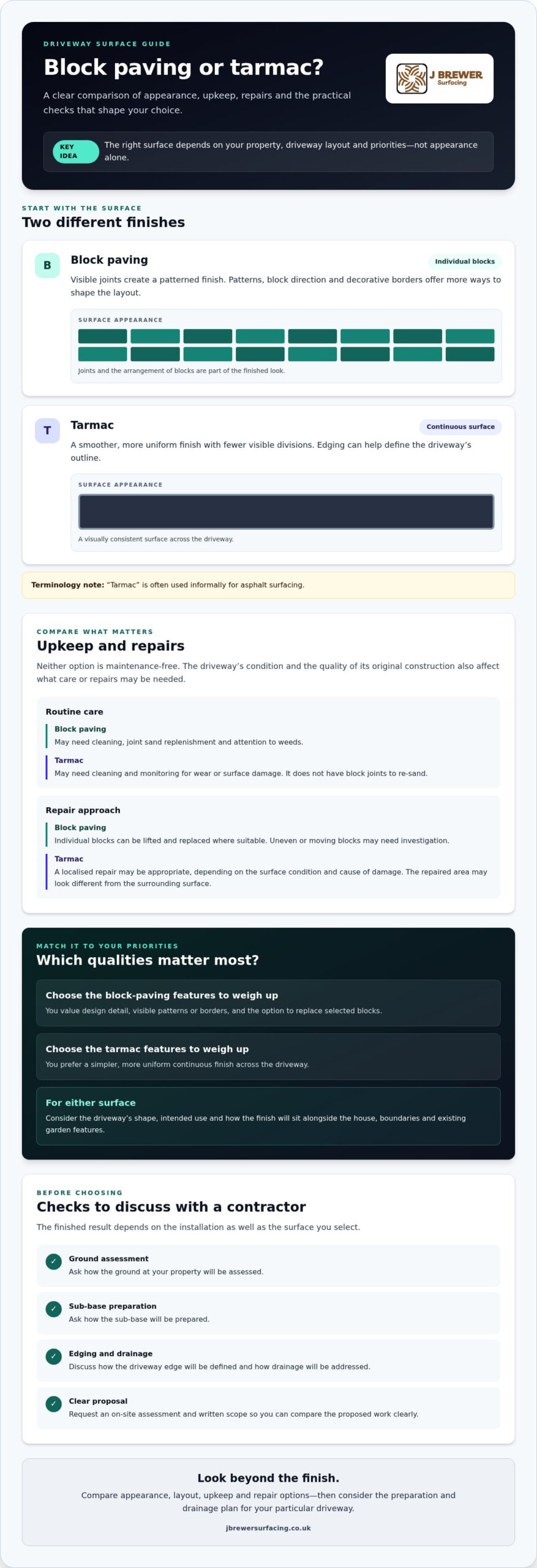
Both block paving and tarmac can suit a driveway. The better fit depends on your property, layout and priorities. Block paving is made from individual blocks laid together, while tarmac creates a continuous finished surface. That difference shapes the look, design options and typical approach to repairs.
The word “tarmac” is often used informally for asphalt surfacing. For background on the material, see Asphalt concrete. Whatever surface you choose, the finished result also depends on the installation, including ground preparation, edging and how drainage is addressed.
| What to compare | Block paving | Tarmac |
|---|---|---|
| Appearance | Individual blocks create visible joints, with patterns and borders offering design choice. | A more uniform, continuous finish, with fewer visible divisions across the surface. |
| Layout flexibility | Patterns and borders can help define areas or follow the shape of a driveway. | Works as a consistent surface across the driveway, with edging helping define its outline. |
| Upkeep | Joints may need re-sanding, and weeds may need attention. | Doesn’t have block joints to re-sand, but still needs checks and care over time. |
| Repair approach | Individual blocks can be lifted and replaced where appropriate. | Repairs generally involve treating an affected section, which may look different from the surrounding surface. |
How do block paving and tarmac differ in appearance?
With block paving, the pattern is part of the design. The arrangement of blocks and a contrasting border can complement a traditional frontage, frame a parking area or link the driveway with the front garden. Tarmac has a smoother, more uniform appearance and may suit homeowners who prefer a simpler finish. Look at the house style and surrounding hard landscaping together, rather than judging the driveway on its own.
What should homeowners compare before choosing?
Decide whether you prefer visible joints and design detail or a continuous surface that follows the driveway’s shape. Routine care differs from repair: block paving may need joint sand replenished and weeds addressed, while either surface can need attention if wear or damage develops. Neither should be treated as maintenance-free.
Block paving: individual units offer pattern choices and the possibility of replacing selected blocks. Tarmac: a continuous finish gives a more uniform look, with repairs typically focused on the affected area. For either option, ask how the contractor will assess site preparation and drainage at your property.
Block paving vs tarmac driveway: appearance, maintenance and repairs
The differences become clearer when you consider how each surface looks after installation and what caring for it involves. The comparison below is a starting point. The driveway’s condition and the quality of its original construction also affect what maintenance or repair may be needed.
| Consideration | Block paving | Tarmac |
|---|---|---|
| Appearance | Visible blocks and joints create a patterned finish. | A more uniform, continuous surface. |
| Design flexibility | Patterns, borders and contrasting blocks can shape a bespoke layout. | Edging helps define the outline, while the main surface remains visually consistent. |
| Routine care | May need cleaning, joint sand replenishment and attention to weeds. | May need cleaning and monitoring for wear or surface damage. |
| Repairs | Individual blocks can be lifted and replaced where suitable; movement may need investigation. | Localised repairs may be appropriate, depending on the surface condition and cause of damage. |
Which driveway surface gives you more design flexibility?
Block paving offers more ways to shape the look of the driveway. The pattern, direction of the blocks and decorative borders can define parking areas or pathways. Tarmac has a more uniform appearance, with edging helping create a neat boundary against a wall, lawn or planting. Assess the house frontage, boundaries and existing garden features together, so the driveway feels connected to its surroundings.
What maintenance and repairs should you expect?
Block paving may need deep cleaning and re-sanding as joints need attention. Check for weeds and uneven or moving blocks too, since movement may point to an issue beneath the surface. Tarmac also needs monitoring. Cleaning or a localised repair may be appropriate if wear or damage appears, but the right response depends on the cause. An assessment can help establish what work is needed before repairs are chosen.
Maintenance keeps a surface in serviceable condition: for block paving, that can mean cleaning, replenishing joint sand and managing weeds; for tarmac, it can mean cleaning and watching for changes in the surface. Repairs address damage or movement: selected blocks may be replaced, while a tarmac repair may remain visible against the surrounding finish.
Good preparation matters for either choice. The Concrete Masonry & Hardscapes Association’s interlocking concrete paver installation guidelines describe installation considerations for pavers, including base preparation. For a property-specific comparison, a contractor who works with both materials can explain how layout, ground preparation and edging affect the result. J Brewer Surfacing & Landscaping installs both block paving and tarmac driveways across Hampshire.
Which driveway surface suits your property and priorities?
The right choice depends on how the driveway needs to work and what you want it to contribute to the frontage. Use this decision guide to identify your priorities, then treat it as a starting point: ground conditions, drainage and the proposed construction can affect which surface is suitable.
- Appearance: Choose block paving if patterns, borders and visible detail matter; consider tarmac if you prefer a more consistent, continuous finish.
- Driveway shape: Block layouts can define areas or follow a particular outline. Tarmac may suit a straightforward layout where a unified surface is preferred.
- Upkeep: Be prepared for block paving joints to need attention, including re-sanding and checks for weeds. Tarmac also needs monitoring and may require care or repair as its condition changes.
- Intended use: Think about how vehicles enter, turn and park, and whether the surface needs to accommodate distinct areas. Ask a contractor to assess the actual layout before settling on a material.
When might block paving be the better fit?
Block paving may suit a homeowner who wants to give the frontage a more individual character. Different patterns, borders and contrasting blocks can frame a parking space or complement existing garden features. It may also be possible to lift and replace affected blocks, although the underlying cause of movement should be checked. Factor in periodic joint care and re-sanding when deciding whether this surface suits the upkeep you’re prepared to do.
When might tarmac be the better fit?
Tarmac may appeal if you favour a smooth, consistent finish and have a relatively straightforward driveway shape. Edging can define the boundary against a lawn, wall or planting, without adding a pattern across the main surface. Tarmac still needs attention if its condition changes. Ask how the contractor will assess the base, drainage and edges, as these site-specific details should inform the recommendation.
For a block paving vs tarmac driveway decision, appearance alone shouldn’t settle the question. A property with an intricate frontage may benefit from the design options of blocks, whilst someone seeking visual simplicity may prefer tarmac. The most suitable option may also depend on site conditions that affect the planned installation.
Ask the contractor to explain what they observed on site, how the proposed preparation addresses those conditions and why they recommend one finish over the other. J Brewer Surfacing & Landscaping installs both block paving and tarmac driveways, so you can discuss the alternatives in relation to your property rather than choosing by material alone.
What should Hampshire homeowners check before choosing a driveway?
A surface that suits one property may not suit another, even nearby. Before deciding on block paving or tarmac, consider how the driveway will be used and ask for a site-specific assessment. Don’t assume that ground or drainage conditions are identical across Hampshire.
- Driveway use: Explain how vehicles enter, turn and park, and whether the space needs to serve more than one purpose.
- Layout: Review the width, shape, slope and access points, including any tight turns or changes in level.
- Drainage: Ask where surface water will go and whether the proposed design addresses the site’s drainage needs. Check any relevant planning or surface-water requirements with your local authority before work begins.
- Base condition: Discuss the existing surface and what preparation or sub-base work may be needed.
- Preferred appearance: Decide whether patterns and borders or a more uniform finish better complement the house and garden.
How do site conditions affect the choice?
Ask the contractor to inspect the existing surface, levels, access and likely drainage route, then explain how these observations affect the proposed installation. A site survey helps match the material and preparation to the actual property rather than relying on a general recommendation. Local ground conditions can vary, so ask for the evidence behind any site-specific concerns instead of assuming a particular soil type.
What questions should you ask a driveway contractor?
Ask for a clear account of the ground preparation, sub-base and edging included in the proposed work, as well as how drainage has been considered. Find out what routine maintenance and possible repairs each surface may need. Compare written specifications and relevant project examples, not just labels such as “block paving” or “tarmac”. This makes it easier to understand what will be installed and how it suits your site.
For a block paving vs tarmac driveway decision, these checks help separate personal preference from practical constraints. If your property is in Southampton, Winchester, Gosport, Fareham, Portsmouth, Romsey or Whiteley, J Brewer Surfacing & Landscaping can discuss both surfacing options in relation to your driveway. Discuss your driveway options before committing to a surface.
Choosing between block paving and tarmac: plan your next steps
No single surface suits every home. Balance the appearance you want, the upkeep you’re prepared to do, the driveway’s intended use and the conditions on your site. If you’re still weighing up block paving vs tarmac driveway options, an on-site assessment can help turn those priorities into a practical recommendation.
What should a driveway quotation explain?
Before committing, ask for a block paving driveway cost estimate and written scope that clearly describes what the work includes. It should identify the proposed surface and explain the preparation, edging and any drainage work being considered. Ask the contractor to set out assumptions or exclusions, so you know what is and isn’t covered.
The scope should also outline the maintenance each option may need and how potential repairs would be approached. This helps you compare proposals on the work included, rather than judging them by the surface name alone. If any part of the work or the site conditions is unclear, ask for an explanation before agreeing to proceed.
How can a local contractor help you choose?
A visit to your property gives a contractor the chance to understand how you use the driveway, what finish you prefer and what the existing site may require. Ask how those factors affect the preparation and their recommendation. J Brewer Surfacing & Landscaping installs both block paving and tarmac driveways, and also provides block paving maintenance, including deep cleaning, re-sanding and structural repairs.
Review the recommendation and written scope against your priorities. If both options remain suitable, weigh the design you prefer against the upkeep and repair considerations you’re comfortable with. A clear explanation of the proposed work can make the decision more straightforward without assuming that either surface is right for every property.
For a considered comparison based on your home and driveway, discuss your driveway project with J Brewer Surfacing & Landscaping. Share what matters most to you and ask which options best fit the site.
Choose a driveway that works for your home
The right choice isn’t simply a matter of which surface looks best. Consider how you want the driveway to complement your home, the upkeep you’re comfortable with, how you use the space and what the site requires. For a confident block paving vs tarmac driveway decision, an on-site assessment and clear written scope can help you understand how preparation, edging and drainage fit into the proposal.
Block paving offers more scope for patterns and decorative detail, whilst tarmac provides a continuous, more uniform finish. Both need suitable preparation, and neither should be assumed to be maintenance-free. Let your priorities and the property’s specific conditions guide the recommendation.
J Brewer Surfacing & Landscaping installs both block paving and tarmac driveways across Southampton, Winchester and surrounding Hampshire areas. Discuss your driveway project with J Brewer Surfacing & Landscaping to talk through the options for your property.
Frequently Asked Questions
Which is better for a driveway, block paving or tarmac?
Neither is automatically better. The right choice depends on your property, preferences and how you use the driveway. Block paving offers patterns, borders and visible joints, whilst tarmac creates a more continuous, uniform finish. Consider the driveway’s shape, the appearance of your house frontage and the maintenance you’re prepared to undertake. An on-site assessment can help establish whether the proposed preparation and drainage suit your chosen surface.
Is block paving more hard-wearing than tarmac?
Neither surface is always more hard-wearing than the other. Performance depends on factors such as the site, ground preparation, installation quality, drainage and how the driveway is used. Individual affected blocks may be replaced where appropriate, while tarmac may need a localised repair if damage occurs. Ask a contractor to explain the proposed construction and likely maintenance for your specific driveway.
Does block paving need more maintenance than tarmac?
Block paving has joints that may need re-sanding, and weeds or movement may need attention. Cleaning can also help maintain its appearance. Tarmac doesn’t have block joints, but it still needs monitoring and may require surface care or repair as its condition changes. Upkeep depends on the driveway and its installation. Ask contractors to describe routine care separately from repairs so you can compare the practical commitments.
Can you repair block paving or tarmac if it becomes damaged?
Both surfaces can sometimes be repaired, but the suitable method depends on the damage and its cause. With block paving, selected blocks may be lifted and replaced, while movement may call for investigation beneath the surface. Tarmac may be repaired locally, although the repair can look different from the surrounding area. Have the affected section assessed before deciding on the work, rather than assuming a surface repair will address the underlying issue.
Which driveway surface is better for a sloping or uneven site?
Neither surface is automatically better for a slope or uneven ground. The contractor should inspect levels, access, the existing base and how water will drain before recommending a material and installation approach. Ask how the proposed sub-base, edging and surface will account for the site’s shape. A site-specific assessment matters because a recommendation based only on appearance may overlook practical constraints that affect the finished driveway.
Do I need planning permission for a new driveway in Hampshire?
Not necessarily, but surface-water drainage and the size of the work can affect whether planning permission is needed. In England, a new or replacement driveway over five square metres must use a permeable surface or direct water to a permeable area within the property; otherwise, planning permission is required. Check current requirements with your local planning authority. A new or altered vehicle crossing is a separate matter, so check with Hampshire County Council.
How do I choose a driveway contractor near Southampton or Winchester?
Choose a contractor who can discuss both your preferred finish and the site’s practical requirements. Ask for an on-site assessment and written scope covering the surface, ground preparation, edging, drainage considerations and maintenance expectations. J Brewer Surfacing & Landscaping installs block paving and tarmac driveways and provides block paving maintenance. Its stated service coverage includes Southampton, Winchester, Gosport, Fareham, Portsmouth, Romsey and Whiteley.