
Resin Driveways in Hampshire: 2026 Homeowner’s Guide
The most critical element of an enduring resin driveway is the structural layer you’ll never actually see. When considering a resin driveway Hampshire homeowners often worry about loose surface stones, persistent weeds, or unsightly cracking, particularly given our county’s challenging shift between heavy clay and porous chalk subsoils. It’s completely natural to feel cautious about such a visible transformation; an entrance should provide robust, everyday resilience alongside refined kerb appeal, without leaving you anxious about whether a contractor cut corners beneath the surface.
This guide explains how to choose, plan, and install a durable resin bound driveway tailored specifically to Hampshire properties. You’ll discover the precise groundwork specifications required to ensure lasting stability, clarify the critical differences between fully permeable resin bound systems and impermeable bonded alternatives, and learn how to select UV-stable aggregates alongside a conscientious local installer who builds strictly to British paving standards.
Key Takeaways
- Understand the vital difference between permeable resin bound systems and non-permeable bonded finishes to ensure compliant, natural surface drainage.
- Learn why specifying high-grade, UV-stable aliphatic resin protects your resin driveway Hampshire installation from sun-bleached discolouration and premature cracking.
- Discover how Hampshire’s diverse geological profile, from South Downs chalk to coastal clays, dictates specific excavation depths and structural sub-base engineering.
- Explore how integrating robust boundary restraints, including complementary block paving courses, safeguards edge strength whilst elevating overall kerb appeal.
- Master straightforward seasonal cleaning routines that keep stone pores free of organic debris, securing decades of resilient, weed-free performance.
Understanding Resin Bound Driveways for Hampshire Properties
Whether updating a historic brick cottage in Romsey or enhancing a modern frontage in Fareham, selecting the right exterior surface requires balancing structural durability with architectural harmony. Resin-bound paving achieves this balance by encapsulating washed, kiln-dried natural aggregates within an ultra-clear, heavy-duty polyurethane resin matrix. Because the aggregate is thoroughly coated before installation and hand-trowelled to a uniform profile, the cured surface forms a slip-resistant, weed-suppressing finish that feels smooth underfoot while withstanding relentless daily vehicular traffic.
For any homeowner planning a resin driveway Hampshire architecture offers a broad spectrum of stylistic requirements. Earthy golden gravels complement the warm brickwork and timber frames of rural Winchester homes, whereas crisp silver granites and dark basalts lend striking, clean lines to contemporary developments across Whiteley. This adaptability allows you to preserve the distinct character of your home whilst enjoying a surface engineered for modern demands.
The Crucial Difference: Resin Bound vs Resin Bonded
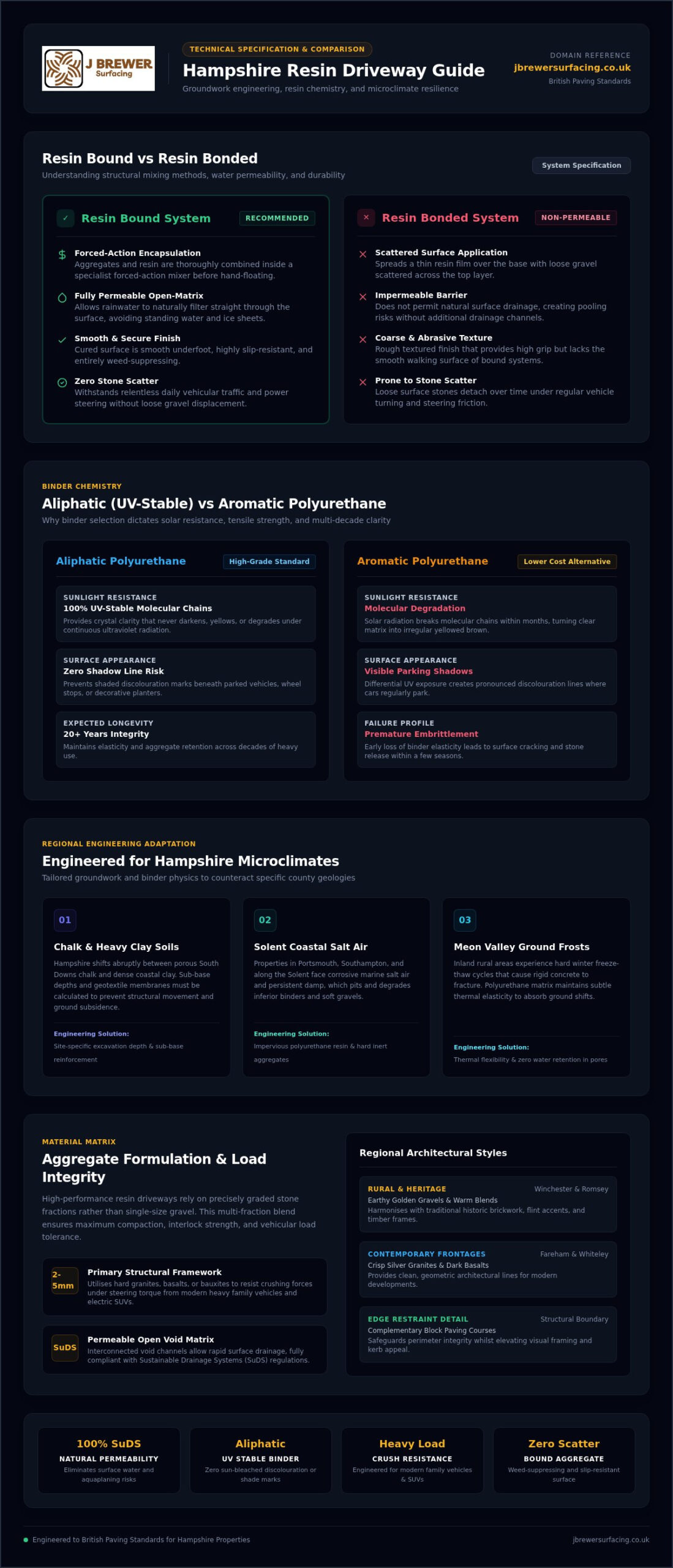
A frequent point of confusion lies in the distinction between resin bound and resin bonded systems. In a resin bound installation, the aggregate and resin are combined inside a specialist forced-action mixer before being hand-floated across the base. This process creates an open-matrix structure that allows water to drain naturally through the surface. Resin bonded surfacing, by contrast, involves spreading a thin film of resin across the driveway and scattering loose gravel on top. This results in an impermeable, coarse finish prone to stone scatter under power steering. For domestic frontages, fully bound systems represent the far superior choice for safety, neatness, and structural longevity.
Why Hampshire Weather and Coastal Climates Suit Resin
Hampshire microclimates present distinct environmental challenges, ranging from hard winter ground frosts across the Meon Valley to corrosive salt winds in Portsmouth and Southampton. Resin bound installations accommodate these regional demands through proven physical strengths:
- Thermal elasticity: Polyurethane resins retain subtle flexibility, expanding and contracting with temperature swings to avoid the brittle fracture lines common in rigid concrete during winter freeze-thaw cycles.
- Coastal resistance: High-grade resins remain impervious to salt air and damp coastal conditions, preventing the pitting and surface degradation often seen near the Solent.
- Rapid rainwater dispersal: Continuous internal permeability allows heavy rainfall to filter straight through the matrix, eliminating standing water, aquaplaning risks, and winter ice sheets.
Evaluating Quality: Resins, Aggregates, and Performance Standards
The chemical composition of your binding agent determines whether your investment endures for over two decades or begins failing within a few short seasons. While an uninstalled mixture looks identical in the tub, binder chemistry dictates tensile strength, solar resilience, and long-term elasticity. When sourcing materials for a high-performance resin driveway Hampshire properties require formulas that withstand sustained summer sun alongside the weight of modern family vehicles, including heavy electric SUVs.
UV-Stable Polyurethane vs Non-UV Resins
Polyurethane binders fall into two distinct chemical categories: aromatic (non-UV stable) and aliphatic (UV-stable). Aromatic resins are cheaper to manufacture, but sunlight degrades their molecular chains within months, turning crystal-clear surfaces into an irregular, yellowed brown. This creates visible shadow lines where cars regularly park or planters sit. In contrast, aliphatic resins provide complete clarity that never darkens or discolours under ultraviolet radiation. Reputable craftsmen exclusively lay aliphatic systems, ensuring the aggregate shades you carefully selected remain pristine year after year.
Selecting Aggregates: Balancing Visual Appeal and Load Strength
A resilient installation relies on meticulously graded stone blends rather than single-size gravel. To guarantee both visual refinement and structural integrity, professional installers blend distinct aggregate fractions:
- Primary structural stone (2-5mm): Forms the load-bearing framework, using hard granites, basalts, or bauxite to resist crushing forces under vehicular steering.
- Fine balancing aggregate (1-3mm): Fills interstitial voids within the larger stone, locking the matrix together without blocking the tiny open pores required by National SuDS standards.
- Rounded natural quartz: Ideal for complementing historic red-brick facades in Romsey or flint-detailed cottages across the Test Valley with warm golden, honey, and autumnal tones.
- Angular crushed granite: Delivers sharp mechanical interlock and clean silver-grey contrast for rendered, modern townhouses in Gosport and Fareham.
Fine sand is often lightly broadcast across the uncured surface during the final hand-trowelling stage. This minute texture creates crucial micro-grip for wet autumn mornings, ensuring safe vehicle braking and confident foot traffic without compromising the sleek, seamless aesthetic. If you’d like expert advice on matching stone textures and colours to your home’s exterior elevations, you can consult the team at J Brewer Surfacing & Landscaping for tailored recommendations.
Groundwork and Permeability: Hampshire Soil, Drainage, and SuDS
A flawless resin topcoat is entirely reliant on the structural integrity of the groundwork beneath it. Skipping comprehensive sub-base preparation or laying over compromised foundations inevitably leads to surface cracking, subsidence, and pooling water. For an enduring resin driveway Hampshire properties require ground engineering specifically designed to navigate the county’s varied geological profile, ensuring rainwater filters naturally through every subterranean layer without shifting the decorative stone above.
Managing Hampshire Geological Conditions
Hampshire ground conditions vary significantly across short distances. Low-lying coastal belts in Portsmouth, Fareham, and Southampton often feature dense, moisture-retentive clay subgrades prone to dramatic seasonal expansion and contraction. Installers must excavate deep enough to remove volatile topsoil before laying a non-woven geotextile membrane to stop fine clay migrating upwards into the stone base. Conversely, chalk-heavy uplands around Winchester and Romsey offer natural drainage but risk crumbling under heavy point loads if not stabilised properly. In both terrains, laying a rigorously compacted MOT Type 3 sub-base, containing reduced fine dust particles, establishes the rigid, open-textured structural foundation needed for full permeability.
SuDS Compliance and Surface Water Drainage
According to official UK government guidance on permeable driveways, front garden surfacing that allows water to soak naturally into underlying ground counts as permitted development. By filtering rainwater through the porous resin matrix, down through an open-graded asphalt binder course, and into the sub-base, fully permeable systems eliminate runoff into overloaded municipal storm drains. This natural soakaway mechanism relieves pressure on local sewer infrastructure during intense downpours whilst saving homeowners the delays and fees associated with standard local planning applications.
Can You Lay Resin Over Existing Concrete or Tarmac?
Homeowners frequently ask if they can reduce excavation costs by installing resin directly over their current drive. The answer depends entirely on the condition of the underlying slab:
- Sound concrete: Can serve as an acceptable base provided it is structurally uncompromised, thoroughly cleaned, primed with a dedicated polymer agent, and installed with mirrored expansion joints to stop ground stress mirroring through the resin.
- Degraded tarmac: Fissured, crumbling, or sunken tarmac must be fully removed, as laying a decorative resin layer over unstable subgrades inevitably triggers reflective cracking across the new surface within months.
A meticulous site assessment ensures you only pay for full excavation when your ground truly requires it.
How to Plan Your Hampshire Resin Driveway Installation
Executing a long-lasting driveway installation demands a logical, phased approach that addresses the physical constraints of your plot before any surfacing begins. Whether you are transforming a broad frontage in Whiteley or modernising an enclosed courtyard in central Winchester, methodical planning guarantees that the finished surface performs as well as it looks. Successful installations progress through five defined engineering stages:
- Step 1: Thorough site assessment: Evaluating levels, boundary constraints, vehicular turning circles, and subsoil integrity to identify required excavation depths and fall angles.
- Step 2: Structural edging installation: Securing permanent perimeters against lawns, walls, and pathways to contain the uncured matrix and protect lateral edges from vehicular override.
- Step 3: Excavation and sub-base profiling: Digging out compromised soil, laying stabilizing geotextile membranes, and mechanically compacting open-textured aggregate foundations.
- Step 4: Binder course application: Installing a permeable, open-graded asphalt layer that provides compressive strength whilst preserving uninterrupted vertical drainage.
- Step 5: Hand-trowelled surface screeding: Mixing stone aggregates with UV-stable aliphatic polyurethane before screeding and floating the mix to a seamless, uniform depth.
Site Preparation and Structural Edging Choices
Resin surfaces require rigid lateral containment because feathering out unsupported edges leads to crumbling under wheel loads. Incorporating complementary block paving borders, granite setts, or sleek aluminium profiles creates an immovable boundary whilst introducing sharp architectural definition against lawns and flowerbeds. This stage also confirms critical falls, ensuring any incidental surplus water is guided safely towards drainage channels or soakaways away from property foundations.
Mixing, Trowelling, and Curing Timelines
Achieving structural uniformity requires mechanical precision on site. Specialized forced-action paddle mixers coat every aggregate particle thoroughly, preventing the weak dry pockets common with standard cement mixers. Experienced screeders then hand-trowel the mixture to a consistent depth of 18mm to 20mm, consolidating the stone to eliminate voids and create a perfectly level plane. Once laid, the surface cures quickly: pedestrian foot traffic is safe after 24 hours, whilst full vehicular parking requires 48 hours for the polymer chains to reach ultimate compressive strength.
If you’re ready to design a robust, SuDS-compliant entrance tailored to your property, plan your resin driveway Hampshire project with J Brewer Surfacing for dedicated craftsmanship from ground preparation to final trowel.
Caring for Your Resin Driveway: Longevity and Specialist Craftsmanship
Sales literature often labels resin bound paving as completely maintenance-free, yet treating any exterior surface with total neglect shortens its lifespan. While it prevents root growth from beneath and avoids standing water, an enduring resin driveway Hampshire homeowners take pride in still requires sensible, routine care. Preserving the open-matrix porosity simply demands keeping organic silt and dirt from settling deep into the aggregate voids.
Seasonal Maintenance and Stain Removal
A simple, consistent upkeep routine safeguards both the structural elasticity and colour clarity of your surface through seasonal changes:
- Autumn leaf clearance: Sweep fallen leaves and organic garden detritus regularly using a stiff, natural-bristle broom. If left to decay under wet conditions, rotting foliage breaks down into fine compost that settles in open stone pores, encouraging airborne moss and weed seeds to lodge and germinate.
- Prompt oil remediation: Treat motor fluid drips or household barbecue stains immediately. Apply warm water mixed with standard household washing-up liquid, agitate the area gently with a stiff hand brush, and flush thoroughly with cold water to break down greasy films before they cure.
- Controlled pressure washing: Annual cleaning lifts settled atmospheric grime, but excessive water pressure can dislodge stone. Keep the pressure washer set to a moderate output, fit a wide fan-spray nozzle, and maintain a consistent working distance of at least 300mm rather than concentrating high-pressure pencil jets directly onto aggregate seams.
Why Work With J Brewer Surfacing & Landscaping
Surface longevity starts with master craftsmanship at the groundwork stage. J Brewer Surfacing & Landscaping delivers dedicated residential and commercial installations across Southampton, Winchester, Portsmouth, Fareham, Gosport, Romsey, and Whiteley. Because our own local team manages every stage, from laser-guided excavation and sub-base compaction through to hand-trowelled resin application, we guarantee that every layer adheres strictly to British paving standards.
We also understand that an entrance rarely exists in isolation. Our versatile tradespeople provide complete exterior coordination, integrating complementary block paving aprons, custom fencing solutions, and bespoke patio installations. Choosing an established, accountable specialist gives you lasting confidence that your property investment is in capable, conscientious hands.
Elevating Your Home with Enduring Resin Craftsmanship
Investing in a resin driveway Hampshire homeowners can truly rely on pairs architectural refinement with effortless daily practicality. Genuine surface longevity comes down to two uncompromising standards: pairing certified UV-stable aliphatic binders with robust sub-base engineering designed around our region’s shifting chalk or clay soils. Getting these groundwork fundamentals right eliminates standing water, prevents frost fractures, and ensures your chosen stone aggregates maintain their vibrant tones for decades.
An entrance shouldn’t just handle vehicle traffic; it should harmonise seamlessly with your wider outdoor environment. By uniting your resin surface with complementary block paving courses, bespoke patio installations, or custom fencing, you create a cohesive arrival space that enhances everyday living. Request a bespoke resin driveway survey from J Brewer Surfacing today, and let our dedicated local team bring methodical groundwork, honest guidance, and enduring craftsmanship to your property.
Frequently Asked Questions
How long does a professionally installed resin driveway typically last?
A properly engineered resin bound driveway typically lasts between 20 and 25 years when installed over an appropriate sub-base. Longevity depends on selecting UV-stable aliphatic polyurethane binders and washing away organic leaf debris before it can decompose in open pores. Routine care ensures the elastic resin matrix withstands heavy daily vehicular traffic without fracturing, ravelling, or losing its vibrant aggregate colour.
Do I need planning permission for a resin bound driveway in Hampshire?
You don’t generally need planning permission if you install a permeable resin bound system. Because the surface complies with national Sustainable Drainage Systems (SuDS) standards, rainwater naturally infiltrates the ground instead of overwhelming local storm networks across Southampton or Winchester. However, properties situated within designated conservation areas or involving listed buildings may require specific council consent, whilst dropping a kerb always requires Hampshire County Council approval.
Can a resin bound surface crack or lift over time?
A resin bound surface won’t crack or lift on its own, provided the underlying sub-base is structurally stable. Cracking almost exclusively happens when rogue contractors cut corners on groundwork or lay resin over moving, broken slabs. When our team excavates to suitable depths and installs a reinforced, open-graded asphalt binder course, the cured surface retains enough subtle flex to handle seasonal ground movement without lifting.
What is the main difference between resin bound and resin bonded systems?
The fundamental distinction lies in permeability and aggregate encapsulation. Resin bound systems mix stone aggregates thoroughly with polyurethane inside a forced-action mixer before trowelling, leaving open void spaces that allow water to drain freely. Resin bonded paving simply spreads resin across a solid base and scatters loose gravel over the top, resulting in an impermeable, coarse surface that can’t meet SuDS criteria and sheds loose stones over time.
How soon can I park my car on a newly laid resin surface?
You can safely park passenger vehicles on the driveway after 48 hours of curing. Pedestrians can walk across the surface after approximately 24 hours, but vehicles impose significant point-load forces through their tyres. Giving the polyurethane binder a full two days allows the chemical chains to cross-link completely. This patience prevents premature scuffing or indentation, ensuring your new entrance achieves maximum load-bearing resilience.
Can a resin driveway be laid directly over my existing concrete or tarmac?
Overlaying is possible, but only if the existing foundation remains structurally sound, level, and free of active movement cracks. For a newly overlaid resin driveway Hampshire surveyors first inspect the slab for subsidence and oil contamination. If concrete is solid, installers apply a specialised polymer primer and reflect existing expansion joints. Severely cracked or rutted tarmac, however, requires complete excavation down to fresh ground to avoid reflective surface failure.
Are resin driveways slippery to walk on during freezing Hampshire winters?
Resin bound surfaces provide exceptional natural grip and aren’t inherently slippery during cold weather. Because water permeates straight through the porous matrix rather than puddling, surface ice sheets rarely form after southern frosts. During installation across towns like Fareham, Portsmouth, and Romsey, our fitters lightly broadcast fine crushed glass or quartz sand across the wet resin, creating a tactile micro-grip texture that enhances pedestrian footing and vehicular traction year-round.